A Proposal for an Ethical Compass with 6 Principles to Guide Future Innovation

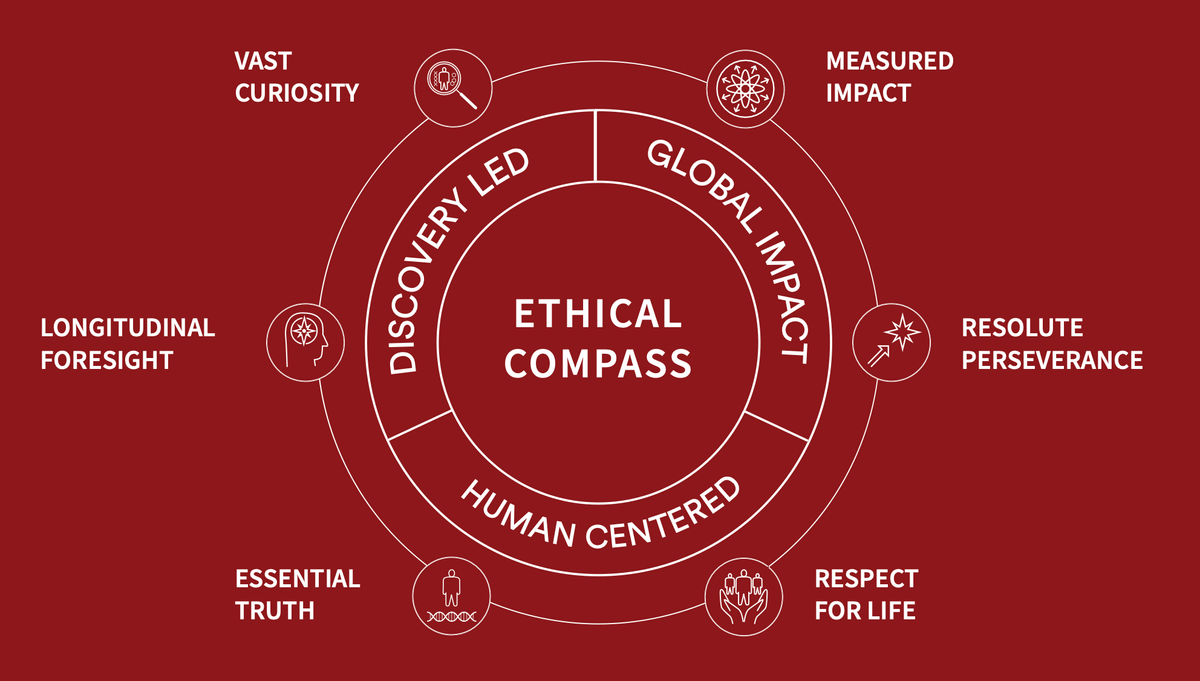
I have had the great honor to work with Stanford Medicine along with the School of Medicine. In my endeavors consulting with them, I proposed a framework for guiding ethical innovation and research discovery initiatives. While this tool was not adopted by Stanford Medicine, it is a body of work that I remain proud of and hope may be beneficial for others. The ethical compass below is a tool that I utilize to evaluate my own work.
Integrity is at the core of Stanford Medicine’s quest to heal humanity. As we navigate the unprecedented challenges of today’s world, six principles guide us in each clinical encounter, each research project, and each step along the path of Precision Health. These principles form our ethical compass.
Ethics has never been simply about choosing between right and wrong— that’s easy. From the ancient philosophers to the state-of-the-art research conducted at SPHERE—the Stanford Precision Health for Ethnic and Racial Equity Center—the Stanford Center for Biomedical Ethics, or the Women and Sex Differences in Medicine Center, ethics often are a matter of striking a meaningful balance between competing goods: promoting health and curing disease; understanding population trends while focusing on an individual body; long-term benefits to society and the immediate needs of a patient in distress; patients’ expectation of privacy and the needs of the scientific community for access to clinical findings, data sets, and demographic trends.
It would be misguided to search for a rigid formula to encompass such rapidly evolving fields as artificial intelligence, genomics, or the latest discoveries in neuroscience. This was the dream of Leibniz: ”When there are disputes among persons, we can simply say: calculemus [‘Let us calculate’], to see who is right.” But that was 1685, and until some algorithm is devised that can map the route to the philosopher’s “best of all possible worlds,” Stanford Medicine is guided by a set of principles: vast curiosity, deep discernment, essential truth, measured impact, resolute perseverance, and respect for life.

VAST CURIOSITY
The history of science is littered with examples of accidental discoveries, chance findings, and unexpected correlations. What they have in common is a climate that allows researchers the freedom to exercise their scientific curiosity and pursue hunches and hypotheses. By fostering this kind of climate, Stanford fosters curiosity that manifests in innovative collaborations with healthcare and technology companies, the pairing of social and natural scientists to study bias inherent in datasets and its implications, and long-term basic research into the growth of brain cells that is yielding insights into personalized psychiatry.

LONGITUDINAL FORESIGHT
As developments in research and – particularly – machine learning and artificial intelligence make it possible to identify microscopic tumors, compare and correlate vast and seemingly unrelated data sets, and predict the migration of infectious diseases, medical professionals are free to focus attention on skills that are uniquely human. We are able to make judgments. Exercise compassion. Reach across domains. Decide whether to break news to a patient by phone, email, or in person. Technology creates time and space for more human interactions and for nuanced decisions that are critical to successful care.

ESSENTIAL TRUTH
The freedom that the use of AI offers to medicine requires attention to and understanding of the purity and accuracy of data and the systems we use to analyze it. Stanford Medicine must uphold the highest standards to reveal and remove any intentional or unintentional biases that could harm individual patients or compromise broader health outcomes and protections for society at large. Integrity and truth require us to find a syzygy of benefit and protection

MEASURED IMPACT
Our objective is simple: Stanford Medicine wants nothing less than to impact 2.5 billion lives by the year 2025. This encompasses everything from the delivery of a healthy baby, pioneering new cures and procedures, and deciphering long-term trends in public health. By sharing clinical, research, and educational expertise worldwide, Stanford is making patient-centered healthcare accessible across borders and cultures. In the pursuit of these ambitious goals, we take measured steps to ensure we scale safely.

RESOLUTE PERSEVERANCE
A physician’s commitment to fight for a patient’s life; a professor’s desire to see every student succeed; a scientist’s passionate pursuit of a potential research breakthrough. Throughout Stanford Medicine, determination, dedication, and perseverence lead to success: from late nights spent by care teams working to reach a compassionate use approval from the FDA, to years of careful and collaborative research that eventually paves the way for new treatment.

RESPECT FOR LIFE
At the core of everything we do—across every branch and every discipline that comprise the totality of Stanford Medicine—is respect for the dignity of life, the uniqueness of each human being, and the right of each patient to choose their healthcare path. This means accepting the risks inherent in a first-ever surgery to heal a patient with no other options, understanding the balance between quantity and quality of life for a terminally ill patient who may benefit from palliative care, and – for every patient – keeping the patient at the center of precision medicine.
These principles do not tell us what to do in every instance. It can be difficult to know when to end a clinical trial, whether to prescribe or withhold an experimental drug, or whether or not to proceed with an untested medical procedure. But together, they create a framework within which we can, on the basis of common goals and shared understandings, make the sound, humane judgments that are integral to world-class healthcare.
“WE MUST FIGURE OUT HOW TO REGULATE THE NEGATIVE CONSEQUENCES OF TECHNOLOGIES WITHOUT STIFLING WHAT FUELS INNOVATION.”